I'm getting aggravated by this market again. Not a lot of great opportunities offset by what I perceive as perilous macro environment. It really is a time to stick to my guns, and just focus on learning.
So far my performance this year has actually been very good. Up 2%, while I'm only running 5.5% net exposure. In other words, I've kept up with half of the S&P's move (up 4% YTD) while being 94.5% not invested.
Wednesday, January 18, 2012

Saturday, December 3, 2011
Kyle Bass and the Coming Global Forest Fire
I believe that if you are a citizen anywhere in the world, this is probably the most important video that you could watch this year. Yes, the interviewer with his twirling glasses is full-of himself and really annoying, but Kyle Bass makes up for it with his genius.
Kyle Bass Interview
Kyle Bass Interview
Understand Long Term Valuations and Expectations

While I'm not going to walk through the details of the calculations, I'll summarize the conclusion: The red-line looks at 15-year returns following a given year. Hence the reason why the red-line stops in the mid-90's (It's nearly 2012, so 15 years ago ~1997). So you can see that the market since 1997 has returned about a ~4% annual return (technically ~3.66% per annum from November '07 to November '11).
The blue line, shows what the 15-year returns would have been forecasted at any given date by looking at a 10-year average multiple for the S&P, inverting it (so 20x 10-year average is a 5% return) and making some adjustments for inflation.
As you can see, over a long period of time, the returns of the market over any given 15-year period, haven't deviated too far from what a 10-year valuation would imply. This seems logical enough. After all, if you pay too much for an asset, the returns will be lower, and if you find a bargain, your returns should be higher.
The current market environment implies that over the next 15-years, the total return will likely come between -2% per year to +2% per year.
Yet another clue that after a market rally like this past week, it's good to sit on cash and wait for dramatic bargains. It's just a matter of waiting. If the market continues to rally, the 15-year forecast will likely go negative, in which case I'll consider increasing my 13% S&P short position.
-------
Just as a follow up to this post. Let's say the above forecast is correct (as it has been roughly for the past several decades) and the market is set to compound at -2% to 2% per annum over the next 15-years (technically its closer to zero but let's put a range on it). If we want to assume the optimistic scenario, the upper range, we use 2% per year. This implies that the S&P can increase by about ~35% over the next 15 years, from ~1,244 to ~1,674.
This really helps justify my big S&P short position. There are all these huge macro risks that can tank the market in the coming months and if none of them play out, in all likelihood, the most I'll lose on my short is ~35% over 15 years. In contrast, all the stocks I own can compound at 8%+ per year (through shareholder returns and growth), and I think could easily increase by 50-100% in the next 3-5 years (barring a macro collapse). Feels like a the right set up, but at the same time, I don't want too much net exposure (aka if I buy a stock, I'll offset the equity exposure by shorting the S&P).
Wednesday, November 30, 2011
Santa Rally Follow Up
The market was up 4% today.
Below is a link to an article explaining why (China lower rates, coordination with multiple central banks lowering the rate on funds that are borrowed during emergencies).
Forbes Article
I thought about covering my 13% S&P short at the open, but decided to hold on for a few reasons: 1.) this seems like an act of desperation (they're lowering the emergency overnight rate, because they don't have any other policy options left) and 2.) the structural problems in Europe are unaddressed.
My friend Steve described it as laying foam on the run-way ahead of a plane crash. I like the analogy.
In the mean time, I'm trying to live the value life style: Look at stocks that I think have deeply compelling business models that will prosper for the next 20-30 years and make a list waiting for them to come down to attractive prices.
There's a reason that so many value investors live and work to past their 70's. It's because the lifestyle is much easier. It's not as stressful. You sit on your ass and enjoy the day reading about great businesses. All the while you wait for good opportunities. If there's no good opportunities today, go home earlier and read about something fun. At most, maybe you get a couple of opportunities a year.
What a great model.
Sunday, November 27, 2011
Thanksgiving 2011
Bloomberg had an article on how the S&P had its worst Thanksgiving week since 1932, the Depression.
S&P Worst Week Since '32
Before going into my strategy for the rest of this year, I need to acknowledge that my call for a market crash in October was dramatically wrong and reflects my inability to call the market. Instead the market sharply rallied and my hedges cost me a lot of money. For a brief period my performance looked particularly lackluster as the broad indices were positive for the year, while I was still down ~1-2%. Since the October rally, I exchanged my stock specific hedges for an S&P short that I don't have to roll-over each month and pay the option premiums.
While my views of the market are below, my strategy remains largely the same: sit on cash until you find great businesses at good prices. There are a few that I've come across over the past few weeks, but nothing that I've bought in size as I'm still waiting for a broad market capitulation in the coming months or years.
I'm planning on two separate outcomes for the remaining of the year:
1.) Usually this time of year there is a Christmas / Santa Rally. It's bonus season and it helps put Mr. Market in the mood for the season's cheer. That said, with the S&P down ~8% YTD and layoffs announced in the thousands it's hard to see a strong rally. Perhaps it could come from a delusional life-line that the ECB will save Europe. It wouldn't be the first time the market went up on a hope and a prayer, just look at October this year.
This view is already partially confirmed as I look at my Bloomberg -- U.S. futures indicate a strong market opening on Monday morning "amid speculation the International Monetary Fund will help Italy after the nation's borrowing costs surged." Its funny how the short-term "fixes" that neglect the structural problems can still get the market's animal spirits going. It was only a few weeks ago in October that the market was surging on France's "ultimate solution" and only a few months ago where many said "there's no such thing as a new normal."
If we do get a broad market rally I will likely take it as an opportunity to unload some of my less favored positions like TSRA, SWY, and the remainder of my Japanese basket. The goal would be to free up some cash for better opportunities in the future. Maybe I'll even consider adding to my S&P short. I currently have ~20% gross long exposure, ~7% net.
2.) If the market continues to sell-off I'll probably just sit tight. Human nature being what it is (you can debate on whether its optimistic or predictably stupid), I view this scenario as less likely. Given my low net exposure, I'm happy sitting tight. Maybe I'll even consider some small purchases or locking in some profits on my S&P short depending on how far the market drops. I expect the market will ultimately breach its September / October lows, but we may have to wait until 2012-2013.
Overall I still view the economic landscape as a mine field where any day in the future you can wake up to discover the market is down 5%+ on a major "surprise" headline: "Greece Defaults", "Italian Debt at 10%", "Israel Strikes Iran Nuclear Facilities - Oil Price Shock", "Japanese / French / U.S. Debt Downgraded","Major European Bank Run", etc.
These are perilous times and I think the right play is from the story of "Farmer Womack." Sitting on mostly cash and waiting for the moment when everyone else is depressed and has little hope of the future. Then you buy.
Wednesday, October 19, 2011
Best Summary of the Recession Risk I've read
Recession Summary from Kelpie Capital
What a fantastic summary.
The only thing missing is the list of over-leveraged banks in Europe that Hussman included in his most recent weekly write-up. Found here.
What a fantastic summary.
The only thing missing is the list of over-leveraged banks in Europe that Hussman included in his most recent weekly write-up. Found here.
Tuesday, October 18, 2011
Another Day in the Grind
I currently have a ~8% short against the S&P and another 6% of the portfolio is in puts that offset long-positions (CA / SWY / WFC). My net exposure is 4%.
Holding my shorts / hedges are brutal. They've been wearing on me and I've been sleeping less. My wife says I'm not stressed, just tense. And of course, she's right.
I've been trying (poorly) to trade the S&P short, but I think I may be falling into the pot committed stage where I just push my S&P short and hold it. How much higher does the market go on speculation of an all encompassing European solution?
Just look at how this crisis has evolved. Greece was the focus. Now the focus is on saving the banks because, whoops, it's very likely that Greece will default. So then the European regulators run some bank tests and say all banks are fine with Dexia at the top of the list for clean health. Then, whoops, a few weeks later, Belgium and France race to save Dexia.
The world I look at (not my personal world, but the world at large) is filled with unhappy people, high unemployment, a government looking to tighten its belt (U.S.), and an entire continent with a financial bomb waiting to implode (Europe). This is depressing, so I short and I'd like to gain from when the market eventually implode.
I'm only down 1.7% YTD, but gosh, waiting for the next great time to swing for the fences is a grind.
Monday, October 17, 2011
Occupy Wall Street and other Protests
I figured it's only a matter of time before a friend or family member asks me about the protest, so I wanted to sum up my thoughts:
While I think the group is largely unfocused, misguided and uninformed, I'm actually mixed on the whole thing. This is due to the fact that I have no idea what the secondary effects will be. And, I believe like most things, it should be judged by the secondary effects.
If protesting helps future college students choose engineering over economics, it's a positive for society. More doctors and engineers and fewer hedge fund managers is good.
If massive protests prevents excess corporate greed (however unlikely). Another plus.
If, however, a major financial institution collapses because it doesn't receive the government support it needs because politicians are too concerned about their next election and appeasing the loud voices of a protest, then this is clearly not good.
So net, I'm not sure. If another major bank collapses we'll all be out of work - doctors, engineers and hedge fund managers.
Sunday, October 16, 2011
Buy on the Rumor, Sell on the News
There's an old Wall St. adage that says "buy on the rumor, sell on the news."
Since 10/3/11, the market has rebounded over 11% on the prospect of a European solution that will both fix the sovereign debt crisis as well as the over-leveraged nature of their banking system. I suspect that this rally is largely a head-fake and my attention is better spent focusing on what companies to buy when the market ultimately reverses.
Despite my efforts to maintain emotional tranquility, this rally irritates me. It irritates me because it wears on my discipline in remaining mostly not invested. It's hard to watch a market rebound 11% and not think, "great I just missed a buying opportunity," or "if this rally keeps going, I'm going to
look like a fool." That's the hard part of investing, the value grind. Maintaining your discipline and sticking to your guns on what prices to pay for different companies is one of the hardest parts of investing (and I would argue, even harder then watching a stock you own drop in value).
This is where the value philosophy is so helpful. Instead of getting annoyed over the markets ability to pump up stocks on speculation of a European panacea, I should just smile and say, Mr. Market is here to serve me. Today he is not offering me anything I want, but maybe tomorrow he will.
In the mean time I wait, and wait, and wait.
Monday, October 3, 2011
The Rest Will Read Like Fiction and Why S&P Can Drop to 550 (or lower)
In an interview today on CNBC, Michael Lewis said two things that were exceptional:
My favorite comment was how we're starting to go through Act II of the 2008 crash and as more investors realize this "the rest will read like fiction."
He also said the following:
“A banking system is an act of faith: it survives only for as long as people believe it will.”
While I'm not happy to be down, I'm actually quite pleased by my return so far this year: -2% vs. -12%+ for the S&P and -22%+ for the Russell 2000. This is how real money is made. Waiting for crashes and buying.
Why S&P Can Drop 50%
I'm out of time for why I think the S&P can drop to 550, so I'll summarize in abbreviated bullet form:
My favorite comment was how we're starting to go through Act II of the 2008 crash and as more investors realize this "the rest will read like fiction."
He also said the following:
“A banking system is an act of faith: it survives only for as long as people believe it will.”
While I'm not happy to be down, I'm actually quite pleased by my return so far this year: -2% vs. -12%+ for the S&P and -22%+ for the Russell 2000. This is how real money is made. Waiting for crashes and buying.
Why S&P Can Drop 50%
I'm out of time for why I think the S&P can drop to 550, so I'll summarize in abbreviated bullet form:
- S&P trades at 1099 right now.
- Analysts estimate that the companies represented will generate 90 in earnings so ~12x earnings.
- Cheap, right? Wrong.
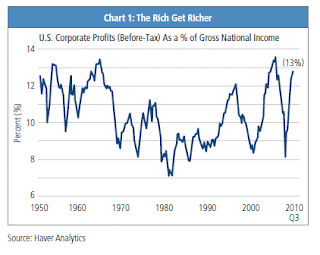
- Profit margins are at or near a record high. One way to show this is how U.S. Corporate Profits (pre-tax) are near a record high relative to Gross National Income (13% vs. average of lets guess 10%). See chart below.
- Based on this if we assume S&P earnings come down 25%, then the S&P will generate ~70 in earnings.
- Historically bear markets have bottomed closer to 7-10x. An 8x multiple would imply 550 on the S&P. Not good.

Sunday, October 2, 2011
Record Low Net Exposure - Preparation for a Crash
My net exposure is currently ~3%, an all-time low. I think the 3 macro conundrums I highlighted a few weeks ago still drive the markets, none of which have given an "all-clear" signal. If anything Europe seems like its running out of options.
I was surprised, however, that the U.S. Congress was able to get their act together and the government did not shutdown for lack of reaching a stop-gap funding measure at the end of September.
Soft-signs that I'm closely watching are Crude and Copper (which are making year-low's as I write) and BNP Paribas (a pulse on Europe's financial system).
All this being said, it makes me uncomfortable to bet against the Oracle who maintains that it's "very, very unlikely" to have a double dip.
Why such a low net exposure?
The price movement of the S&P has been extremely concerning as the bounce on 9/26 and 9/27 failed to recover to the prior highs on 9/16 or even 8/31. This pattern looks like lower highs and lower lows. This occurs until the S&P breaches 1100 where it has received support on 3 separate occasions (8/8, 8/19 and 9/22). I think all the traders out there know that if the S&P cracks 1100, the floor may fall out and the S&P may lose a lot in a short period. This all lines up in October, which is already known as a spooky month for investors (e.g. Black Tuesday which lead the way to the Great Depression, occurred on 10/24/1929, Black Monday where the U.S. index fell 23% in a day on 10/19/1987). I think a stock market crash is a possibility in the coming days and weeks and I'm positioned for it.
Sunday, September 11, 2011
Macro Conundrums
There are several macro conundrums that overhang the global economy.
1.) Are Republicans & Tea Party members of congress so committed to their beliefs that they'd be willing to accept a U.S. recession / depression over their beliefs against increasing deficit spending or raising taxes on the rich?
2.) Does the EuroZone have the leadership, infrastructure and mechanisms to handle an over-leveraged, default-prone country? Secondarily, if Europe falls into a recession, will it spread to the U.S.?
3.) Is China in a construction bubble (very, very likely), and what are the global ramifications if it collapses or even slows down (commodity prices, manufacturing equipment, jobs in resource rich emerging economies, etc.)?
I don't have a clean answer for any of these questions, but I think any of them could lead to an economic blow up. As of Friday, my net exposure remained at nearly 10%.
Why France is Fu...
It sure feels like the beginning of a collapse. One small event ignites a chain reaction. But paradoxically, it was not the event that caused the crisis. That blame should fall on the fragility of the system. Note, however, that I am not an expert European banking analyst, but these are my conclusions based on an hour of analysis.
Below is an article titled "Biggest French Banks ... Poised to be Downgraded by Moody's"
Link to Bloomberg Article
So is this rumor mongering, or do the facts justify concern? Let's look at BNP, the largest of the 3 banks mentioned:
As of 6/30/11, BNP has 1.93 trillion euro of assets, offset by 1.84 trillion euro in liabilities. So the equity stake in BNP is a slim 87bn euro. The reason why this is an issue is b/c the leverage (assets dividend by equity) is so very high at 22x. This means that if their assets (loans, available for sale securities, sovereign bonds, etc.) decline by more than 5%, then the equity gets wiped out, stock is worth zero. As of Friday, BNP had a $35bn market cap (according to Yahoo Finance).
Now their Greek bond exposure is only 3.8 bn euros (or 4% of total equity) so it's not enough to kill the bank if Greece defaults. I guess this is why the Bloomberg article suggests Moody's is only looking to lower BNP's rating by "one level."
But I guess the secondary question, and more important analysis, is how much of their 1.93 trillion in assets were from Greece and other struggling European countries? Below is a link to their 2010 annual report:
BNP 2010 Annual Report
I didn't see any chart that gave me a good answer (always a "red flag" when obvious questions aren't quickly and easily answered) so I'm going to use pg. 89, the workforce "breakdown by geographic area" as a proxy. In which case 27% of loans are "Europe (out of domestic markets)" - whatever that's supposed to mean. Let's assume 20% of which (complete guess) is from Greece or 5.4% of the total. BNP has 1.76 trillion in loans and other income producing assets so we can guesstimate that 95bn (5.4% of 1.76 trillion) is linked to Greece - that's more than the total equity value!
This may provide a little context as to why BNP stock has fallen 45% since the beginning of July. The market is saying "dude, you're insolvent."
Friday, September 2, 2011
Parlor Games - S&P Down 2.55%
Well I was wrong about the date of the Obama speech, but everything else seemed to fit my comments yesterday with somewhat surprising accuracy.
YTD I'm down 2.2% vs. -5.4% for the S&P and -12% for the Russell 2000.
YTD I'm down 2.2% vs. -5.4% for the S&P and -12% for the Russell 2000.
Thursday, September 1, 2011
7% Net Long / The Lowest Exposure I've had in Months
It's pretty radical how much my portfolio has changed over the last month.
I don't expect this rally to last and so I put on sizable shorts and hedges today (into the weakness) going from 25% net exposure to 7% in a day. I could change my mind tomorrow in a second as I think there's a good chance that I am too early with putting on this hedge and perhaps the S&P rebounds 5% from here before breaking down again. If I'm right however, and it was the correct call to put on these hedges, then I think it will breakdown swiftly with a 2-3% day tomorrow or next week.
We'll see. This is all a parlor game. The real investing is in figuring out which positions I want to own for the next few years (aka core positions). The hedges are just a way to try to preserve capital in the event of a market collapse where all positions, even cheap stocks, get crushed.
My core positions are currently DCIX / CA / SWY / WFC.
That said, from an economics perspective the market is eagerly anticipating August nonfarm payrolls and unemployment announcements tomorrow morning. I think the clues suggest that it's not going to be good. I guess the first clue is how many companies increased their hiring in August when the Country was facing a default and was downgraded? The second clue is that Obama is giving a speech on jobs today. He probably already knows the jobs figures that will be reported tomorrow, so I'd imagine, this speech is probably timed with a weak figure. Or why else would he make a speech? The third clue is that Obama picked Alan Krueger, to lead the council of Economic Advisors earlier this week. According to the Nytimes, Mr. Krueger is known for his "studies of labor markets."
As I said, this is all a parlor game. I'll take off my significant hedges in the blink of an eye if I think the market is going to keep this rally going.
Sunday, August 28, 2011
The Weak Consumer
I've been reviewing Wells Fargo (WFC) recently as interesting prospective investment (hence the housing analysis yesterday). One of the tables they provide is listed below,which I think reflects the current issue with the U.S. economy. In summary companies have improved but the consumer is still only marginally better.
This is a table of their nonaccrual loans (aka when performance of a loan is not "reasonably assured"). As you can see the consumer nonaccrual loan book has only declined ~12% y/y while commercial has declined by ~25%.

This is a table of their nonaccrual loans (aka when performance of a loan is not "reasonably assured"). As you can see the consumer nonaccrual loan book has only declined ~12% y/y while commercial has declined by ~25%.

Saturday, August 27, 2011
Housing Voodoo
A number of months ago my wife and I checked out a condo for sale near where we lived. Not surprisingly the sales woman not only indicated that it was a "good buy" but that housing prices were likely to recover soon. It was a strange moment for me because I realized at that point I had no idea what housing prices were going to do and more importantly I had heard this before.
It's funny how everyone I know who has shared their two cents on home prices have always employed the same logic: well its gone down so much it's gotta go up soon! But is it really? Gamblers fallacy?
So while I'm no economist, I'm tired of hearing everyone's opinion and wanted to check what the numbers would suggest. Earlier today I came across data from the Census Bureau that shows household income in 2009 dollars going back to 1991 and home prices across the U.S. provided by the Federal Housing Finance Agency over the same period. Now I'm sure there's multiple different types of data to use that shows other perspectives, but this is what was available to me on my quick search.
The data suggests the following story. From 1991 to 2001 household prices gradually increased with household income. I guess this makes sense all else being equal. If everyone makes more money, everyone is going to pay a little more for their home. What's a little surprising is that home prices actually grew slower than household income during this period.
But then, as some would suggest (and I tend to agree), the tech bubble popped and the Federal Reserve lowered interest rates due to fears of a prolonged and deep recession. This in turn encouraged both more lending and lower loan standards. You can see this as home prices dramatically overshot the growth in household income from 2002 and ultimately peaked during the 2H'06 / 1H'07.
Since then U.S. home prices are down ~35-40% through 1H'11. While I don't have the household income data for 2010 and 2011 I'd seriously doubt that it's increased significantly since 2009 which means between 1991 to 2011 home prices AND household income have increased about the same ~75-80%.
I think this is significant because it means that the price declines of the last few years have only wiped away the excess home price growth that occurred from 2002 to 2007. If home prices were indeed depressed, wouldn't they decline relative to household income?
Conclusion - Where to from Here?
So based on this data I think its actually far from certain that home prices should bounce from here. I'm not saying they're going to collapse, but I honestly think up OR down is possible.
After all, if home prices could overshoot on the upside (relative to income growth) why can't they undershoot? Couldn't a weak economy, more cautious lenders, and potential overhang of foreclosed properties result in a truly depressed housing market in the future?

Increased Uncertainty Requires Increased Discipline
It's also worth remembering that in an economic environment of increased uncertainty, I must have increased discipline with investment purchases. My target is to buy fifty cent dollars and scale up if they fall to thirty cent dollars.
After all, it's more painful to reach for a a sixty cent dollar that falls to thirty cents, then it is to miss on the opportunity that a sixty cent dollar goes up 80%.
Or as WEB would say, it's better to make a mistake of omission than commission.
After all, it's more painful to reach for a a sixty cent dollar that falls to thirty cents, then it is to miss on the opportunity that a sixty cent dollar goes up 80%.
Or as WEB would say, it's better to make a mistake of omission than commission.
Friday, August 26, 2011
Economic Improvement or Double Dip? Strategy for Volatility
I'm clueless as to where the market is going from here. Continued economic improvement, or double dip recession? Clearly the market isn't sure either given that it dropped 2% after Bernanke said today he's not pursuing QE3 just yet but nevertheless the market still proceeded to bounce and then rally to end the day positive ~1.5%. Why all the crazy volatility?
Empathizing with the Enemy
There's a phrase about how Wall Street analysts know the price of everything but the value of nothing. In a sense, that is this environment. People are scared out of their willies on the concern that we're going into a double dip. If this happens, everything should be fundamentally worth less (not "worthless") because economic conditions are worse. In which case, don't buy anything, because you'll be able to buy everything cheaper in the coming months.
On the flip side, what if the recent sell-off was just a function of political dysfunction and a ratings downgrade? If that's the case, and the economy is actually fine, shouldn't the stock market rebound to its previous high? If this plays out and you are a hedge fund manager sitting on the side with lots of cash, you're going to look really dumb given that you're now under-performing the market!
So if you bet, and the economy tanks, well, hopefully you lose less than everyone else and investors don't redeem too much of your assets under management. If you don't bet, and the market rallies you face career risk. This reflects the unpleasant set of circumstances for most money managers and I think is the heart of why the market can have such volatile intraday price movements. The market is skittish, because the investors are!
Strategy
My strategy is a bit odd, stressful and more time consuming than usual but it works for me (so far). I'm currently tracking my largest positions and if I notice that the price action starts moving against me, I'll completely hedge my bet with put options. This of course limits my near-term upside if they have 1 or 2 days of favorable gains, but I think it's worth it if a double dip does happen. After all, rule #1 is NOT that you have to make as much money as possible. Rule #1 is "Don't Lose Money."
Despite this focus on preserving capital, I'm currently down about ~2.5% vs. -5% for the S&P and negative 11% for the Russell.
Bargain Bin?
I don't see an overwhelming list of companies that strike me as dirt cheap bargains, so I'm not really expecting to vary dramatically from 20-40% invested. That said I currently only have 20% net exposure as I shorted the S&P yesterday (5% that I'll probably unwind Monday if the market continues to show strength) and I completely hedged my SWY this morning (another ~5% of the portfolio). Both hedges lost me money today, so it's a painful strategy, but I think it's the right one.
Thursday, August 18, 2011
S&P Down 4% (So far today)
The last few days I've spent pairing back my positions. I sold a small stake in RIMM (10% loss), brought down my Japan basket to only 2.4% of the portfolio (from 10% earlier this year) and I 100% hedged out my position in CA with put options.
So net of these actions, I'm only ~20% long. YTD I'm down nearly 3%. Not great, but better than the S&P down ~8%, and the Russel 2000 down 13.5%.
I spoke with a small hedge fund manager based in OC yesterday who is buying on this dip. I think it is the wrong move as valuation still leaves a lot of room to the downside. It's important to recognize that investing is not just psychology (buying when others are fearful), but also when things are dirt cheap.
Subscribe to:
Posts (Atom)